
This is a simple exercise to start articulating your values message.
Finding your values message can only start with you and your colleagues—they are your values, after all. But you can also use this in working with the communities you serve and your allies.
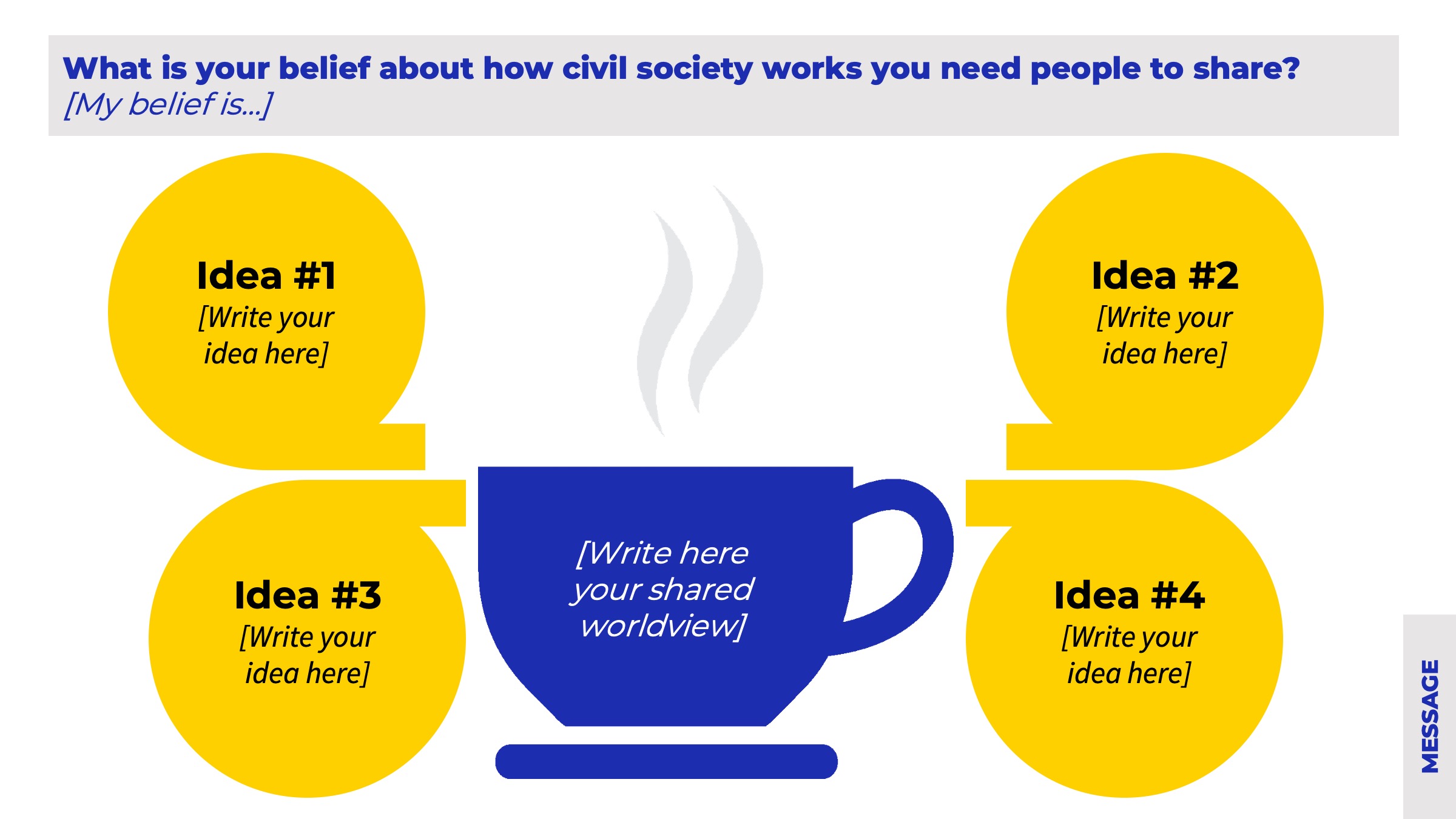
This is a simple exercise that can be done with Post-it notes or an online slide deck. First, ask people to reflect silently on the values that matter to them. Then ask them to write down why they matter in a way that they might explain it to someone else. The key is to write down an idea or belief, rather than just one word.
Then people share in pairs or groups of three to identify a common idea that emerges.
Finally bring everyone together to map out all the ideas, putting together Post-it notes that are related.
To test out whether your idea can be expressed in simple “common sense” language, see how it would look on a coffee cup. Don’t worry about it being a catchy slogan for now. The important thing is that the underlying idea would be an effective way to argue for your cause. To think about the coffee cup is to imagine it in the hands of your target audience, or sitting in the kitchen of a government ministry office—what is a simple message you would want to repeat to decision-makers every day, before they are even thinking about politics?
Remember, the goal is to identify simple phrases that everyone agrees to repeat as much as possible—the simpler the better. For example, instead of “community,” you might say, “All of us need someone else to care about us at some point in our lives” or “We can get more done when we work together.”
Don’t be afraid to use a cliche: Wwe want to actively encourage people to use language that seems trite or overused;, that means it is more likely to be familiar to people.
Here are three things to look for in refining your message.
- Any use of passive tense – this suggests someone or something is being left out of the story.
- Negative language – a world without or “not” means participants need to think of the opposites of the thing they are against and explain why they are desirable.
- Concepts/vague verbs – when participants rely on vague language like “support/implement/fight” ask them to think what that looks like in practice, which will lead into more visual exercises later.
Explore more tools
We use a messaging house to highlight some simple topline messages that we need to repeat over and over again so that they stick in people’s minds.
Rhetorical and policy attacks on civil society are an effort to shrink civic space by destroying public faith in organizations and public motivation for participation.
Here are some tips for how to work with partners to tell narrative-changing stories.
Use this worksheet to draw the picture you want people to see when they hear your message about “civil society.”
Communications strategy outline once you have a clear goal.
Map out the potential supporters who share your values. You want to mobilize and organize these people to spread your narrative for you.
We use a messaging house to highlight some simple topline messages that we need to repeat over and over again so that they stick in people’s minds.